
Do you suffer from bloating, acidity and indigestion after each meal?
Is it hampering your day-to-day activities and even sleep?
Then this article should be of interest to you.
But first let us understand the basics.
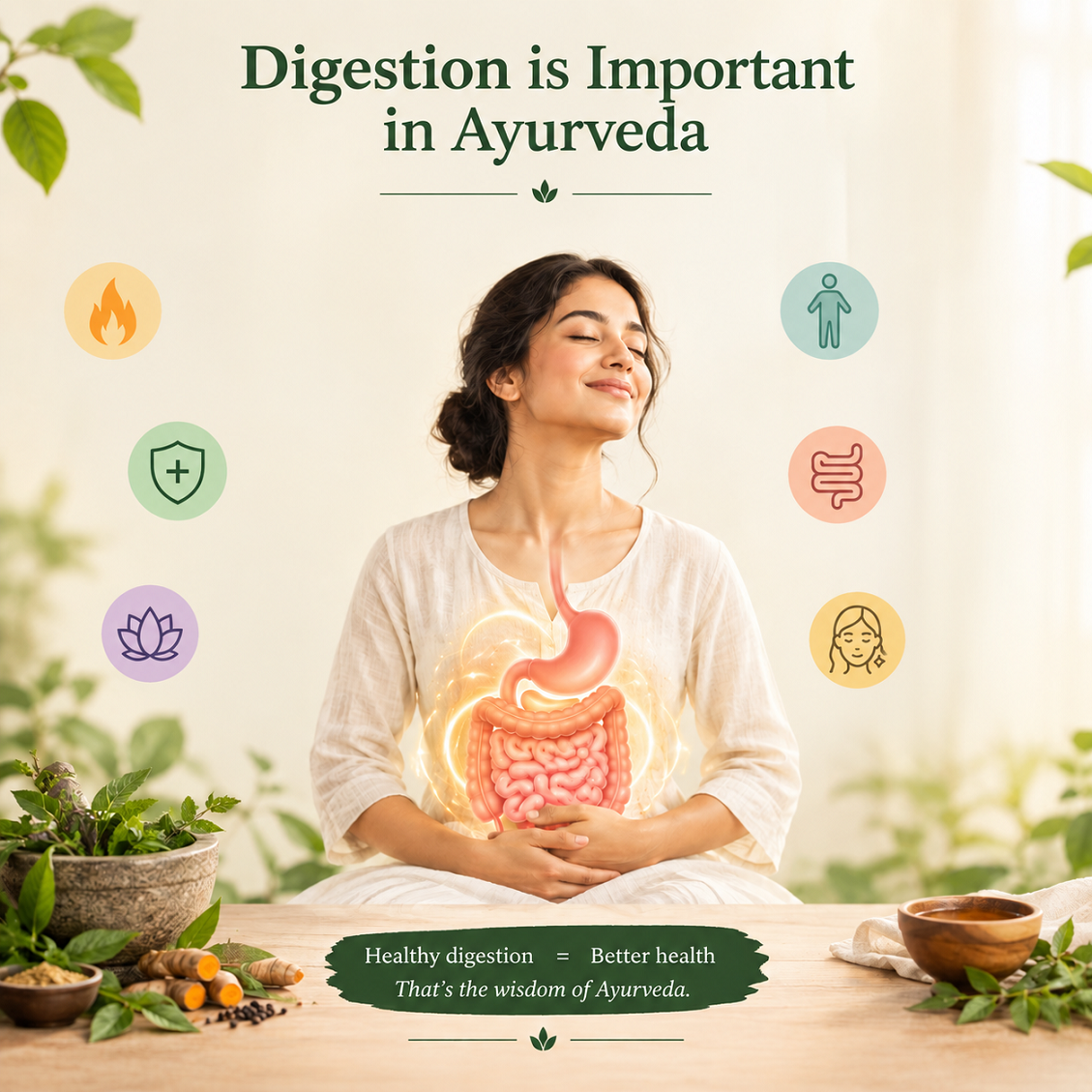
What exactly is the digestive system?
Our digestive system starts at the mouth and ends at the anus.
Crushing of food takes place in our mouth with the help of our teeth making it easier for our body to digest them.
On top of that, the enzymes present in our saliva like Ptyalin which help breakdown carbohydrates into simpler sugars for easier digestion.
Then the foods travel through the esophagus and enter the stomach where the next phase of digestion starts.
Why is digestion central to Ayurveda?
In Ayurveda,the gut is considered as the root cause of many diseases because here the Agni (digestive fire) transforms the food material into usable energy by the body.
If this Agni gets imbalanced, digestion is hampered which may result in the production of undigested food particles (termed as Ama).
This ama is responsible for the formation of many diseases.
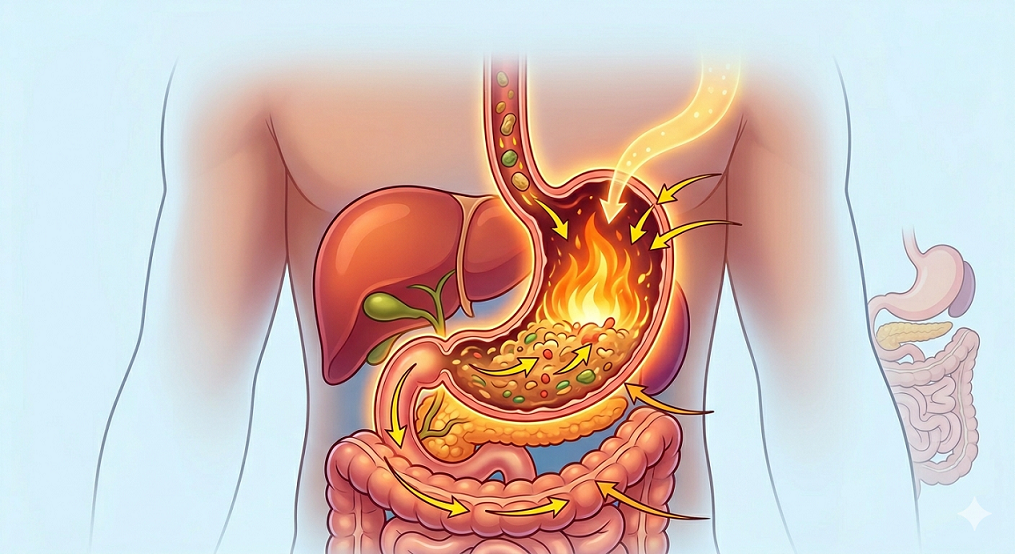
Agni: Its role in digestion and maintaining physiological balance
Agni is the vital biological fire that is located in the stomach and the duodenum (combinedly called Grahani). This is the main component and is also called Jatharagni.
Digestive role-
- Breakdown of complex food articles into simpler forms for better absorption.
- Separation of the useful part from the waste.
- Directs the nutrients into the rest of the GI tract.
Maintaining physiological balance-
- A balanced agni prevents the formation of toxins (ama).
- Sustains the force of life, vitality, energy, immunity and clear complexion.
- Aligns internal biological clock with diet, daily routines (Dinacharya) and seasonal routines (Ritucharya).
When Agni is strong, the body functions better
Signs of a strong agni-
- Right appetite
- Easy digestion
- Regular waste removal
How a strong agni helps the body-
- More energy
- Increased immunity
- Clear mind
- Clear skin
- Balanced weight
What is Ama in Ayurveda ?
In Ayurveda, ama is considered as the toxic residue of abnormal indigestion.
This ama blocks various channels (srotas) which carries nutrients, energy and waste in the body. This blockage is responsible for the creation of various health issues.
Causes of Ama formation inside the body
- Overeating
- Irregular meal timings
- Frequent eating/snacking
- Eating incompatible foods (like dairy products with fish)
- Heavy and cold foods
- Lack of physical activity
- Less intake of water
- Lack of sleep
- Mental stress
Why Ayurveda pays attention to when, how and what you eat?
Daily digestive reactions like bloating, acidity, post meal lethargy are closely linked to what, when and how much you eat.
When you eat-
- Eat the heaviest meal of the day at noon because that is when our digestive system is at its peak.
- Choose an early and light dinner, preferably by 7.
- Our digestion loves regularity. Follow a fixed meal time as much as possible.
How you eat-
- Chew the food thoroughly before swallowing it. Remember, digestion starts in the mouth. So keep it in the mouth for a full process.
- Evaluate what type of food gives you the most discomfort. And simply, avoid it.
- Always opt for a 10-15 minutes post-meal brisk walk. It aids in digestion and also helps in weight management.
- Practice mindful eating. Avoid looking at screens during a meal. Your sense organs must be open to the look, feel and taste of the food.
- Avoid eating under stressful conditions like anger, depression. It hampers the digestion.
What you eat-
- Don’t fill your stomach full. Keep some room for the digestive enzymes to play.
- Watch what you eat. Deep fried and food rich in carbs take longer for the digestion to complete.
- Avoid drinking large quantities of water or any cold drinks during a meal. It hampers with the digestion.
Signs that your digestion may be out of balance
- Bloating and gas
- Acidity
- Constipation or loose stool
- Pain after every meal
- Constant lethargy
- Recurrent infections
- Skin problems
- Improper sleep
Digestion is not just limited to the stomach
Digestion is only the first step of conversion of external food into internal energy and life itself.
By including metabolism, nourishment and elimination, we can see how health is the outcome of all the processes combined instead of a single organ job.
Nourishment:
- Small intestines contain millions of micro- villi which absorbs the nutrients, vitamins and minerals out of the food and into the blood stream.
- If the initial steps of digestion in the stomach are not done properly, then the food passing through the small intestine will be deficient in nutrients resulting in constant lethargy in the body.
Metabolism:
- Once the nutrients enter the bloodstream, metabolism starts to act. Metabolism is the combined reactions of building up (anabolism) and breaking down (catabolism) anything in the body.
- Organs like the liver and the pancreas regulates this process by regulating the blood sugar and processing the toxins.
Elimination:
- It is the detoxification system in the body.
- The kidneys, bowel and the skin help to complete this process.
Other aspects:
- Immunity- about 70 % of the immune cells lives in the gut. So, a healthy gut responds to external pathogens more efficiently.
- Gut-brain axis- there is a two-way connection between the gut and the brain. The gut produces about 90 % of the body’s serotonin. The gut is also called the second-brain. That is why extreme emotions like anger and depression affect the digestion.
- Gut- skin axis- a healthy looking skin is the reflection of a healthy gut. Skin irritations are often linked to disturbances in digestive health.
What Modern Science says about indigestion: Connection with Ayurvedic principles
Some modern findings about digestion, metabolism and the gut-brain axis have interesting conceptual parallels with Ayurvedic ideas.
However, concepts of Agni and Ama should not be considered as direct equivalents of the gut microbiome, dysbiosis or metabolic endotoxemia.
Agni vs Microbiome-
Mandagni and ama conceptually resemble gut dysbiosis (imbalanced gut microbiome) and metabolic endotoxemia (inflammatory byproducts leak into the gut). But the term agni is a metaphor for metabolic efficiency.
The Gut- Brain axis: Manovaha Srotas vs Neural and chemical signaling-
Both the systems agree emotional imbalances disrupt the digestion process.
However, Ayurveda describes it through doshik (predominantly Vata) whereas modern science describes it through vagal tone and hypothalamic-pituitary-adrenal axis activation.
Personalized diet and lifestyle-
Ayurveda focuses on prakriti (body constitution) based diets, dinacharya (daily routine) and ritucharya (seasonal routine) to maintain optimum digestive systems.
Modern science relies on nutrient content and food profiling to suggest the correct diet.
No such seasonal lifestyle approach has been mentioned in modern science as elaborately as in Ayurveda.
The Ayurvedic takeaway: Nourishment begins with digestion
According to Ayurveda, a healthy life begins and ends with the strength of our digestive fire, the agni.
A true health is a reflection of what we are able to digest, not just what we are able to consume.
When we honor our body constituents, practice dinacharya (daily routine) and ritucharya (seasonal routine), we are able to unlock the true potential of our bodies.
By supporting our digestive system, we can ensure that every meal we take become a true source of lasting nourishment.
FAQs :
- What is Agni in Ayurveda ?
The concept of Agni (Jatharagni) is described in Ayurveda as an internal fire located in the Kostha (loosely related to Stomach and duodenum) and is responsible for conversion of the digested food into useful energy for utilization by the body.
- What is Ama in Ayurveda ?
When the agni gets imbalanced, the digestion remains incomplete. The undigested food formed during such a condition is described as ama in Ayurveda.
- What are the signs of weak digestion according to Ayurveda?
Symptoms such as bloating, acidity, constipation or passage of loose stool, skin irritations, disturbed sleep and constant lethargy are some of the signs of a weak digestion.
- What does Ayurveda recommend for healthy digestion?
Ayurveda recommends different methods to keep your digestion healthy- starting from what type of food you eat to when you eat. Seasonal variations of food are also described in Ayurveda.